
Save the ibis campaign
Your Support is important
Sign Our Petition!
The problem
Ibis, known for their long legs and curved bills, primarily feed by probing mud for food. Most of the 30 existing species live monogamously, with a significant portion inhabiting terrestrial and freshwater environments (33.3% and 24.4% respectively), while some adapt to both (24.4%).
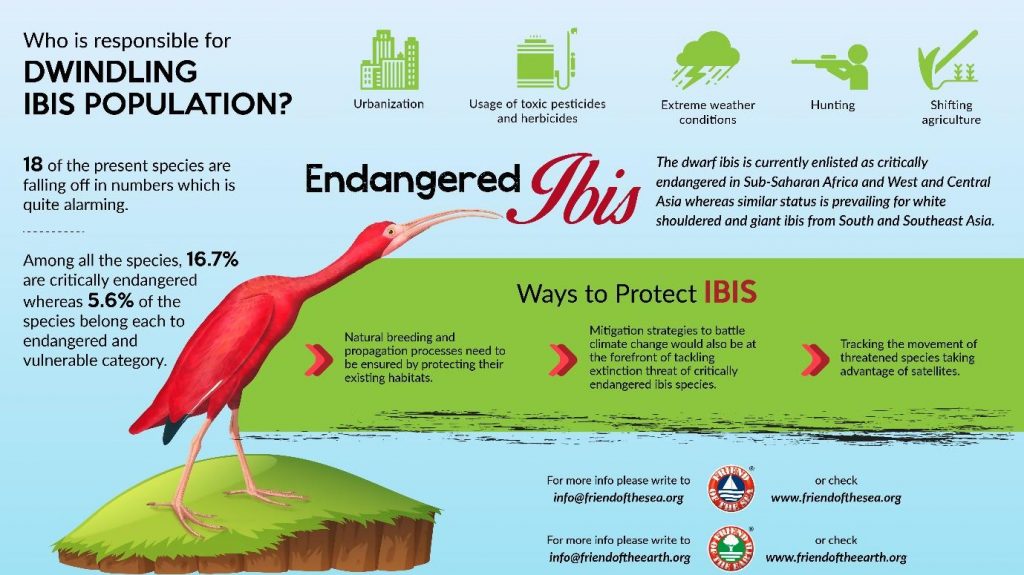
Numerous factors contribute to declining ibis’ populations, including hunting, trapping, logging, and terrestrial plant collection. Habitat degradation from agricultural practices like shifting agriculture, small-holder farming, and agro-industry farming exacerbates the situation. Human activities such as urbanisation, industrialization, pesticide usage, mining, and recreational activities further disrupt ibis’ habitats, leading them to seek new areas for survival. Additionally, invasive species, pests, and pathogens pose additional threats.
Enviromental consequences
Recent IUCN data indicates that 15 ibis species face declining populations. Sub-Saharan Africa has the highest number, with seven species, followed by Southeast Asia with six, and South America with four. Concerning regions include Cameroon, Congo, Ivory Coast, Ghana, Liberia, Madagascar, Sierra Leone, Vietnam, Thailand, Myanmar, and Cambodia, each hosting four endangered species.
Of these species, 10% are critically endangered, 10% endangered, and 3.3% vulnerable. The dwarf ibis is critically endangered in Sub-Saharan Africa and West and Central Asia, while the white-shouldered and giant ibis share a similar status in South and Southeast Asia. Regrettably, the Jamaican ibis or clubbed wing ibis has already become extinct.
Possible Solutions
To conserve the critically endangered ibis’ species, steps must focus on protecting existing habitats and implementing habitat restoration efforts. Strategies related to industrialization, farming, and urbanisation should be adjusted to safeguard ibis’ habitats. Additionally, establishing and effectively managing national parks, wildlife sanctuaries, and protected inland water bodies is crucial, particularly in countries lacking such facilities.
Ex-situ conservation methods like captive breeding and artificial propagation can help increase ibis’ numbers, facilitating their reintroduction to original or new habitats. Successful examples include the reintroduction of the crested ibis in South Korea after 40 years of extinction through captive breeding programmes. Utilising satellite tracking to monitor ibis’ movement is feasible, along with conducting experiments to understand their breeding practices and address threats from alien species and diseases.
WSF’s Activities and Initiatives
WSF has also taken some critical steps as part of its ongoing activity towards certifying products generated from Sustainable aquaculture and agriculture:
- It launched a Change.org campaign to save the following Critically endangered Ibis:
- The White-shouldered Ibis in Cambodia, Indonesia, Lao People’s Democratic Republic.
- The Dwarf Ibis of Sao Tome and Principe.
- The Giant Ibis in Cambodia, Lao People’s Democratic Republic, and Vietnam.
- Communicate with key politicians, industrial bodies, agricultural and aquaculture business owners as well as farmers to notify them about their social responsibilities and act accordingly to protect critically endangered ibis’ species.
- Organise or participate in various seminars, symposiums, conferences to raise awareness among the local communities so that they become educated about these birds and carry out vigilance against illegal hunting and trading of ibis.
Call to action
- Sign WSF Change.org Save the Ibis campaign
- Elect politicians who are committed to environmental Sustainability, e.g., saving threatened ibis species by introducing new laws and activities. For instance, the giant Ibis is a national bird of Cambodia. The Government is waking up to a call to save these birds by introducing a 10-year action plan.
- Establish ex-situ conservation facilities and new national conservation park and in-land water area in countries where it is not available yet.
- Purchase products which are Friend of the Earth certified.
- Increase funding for search on conservation of various threatened ibis’ species.