
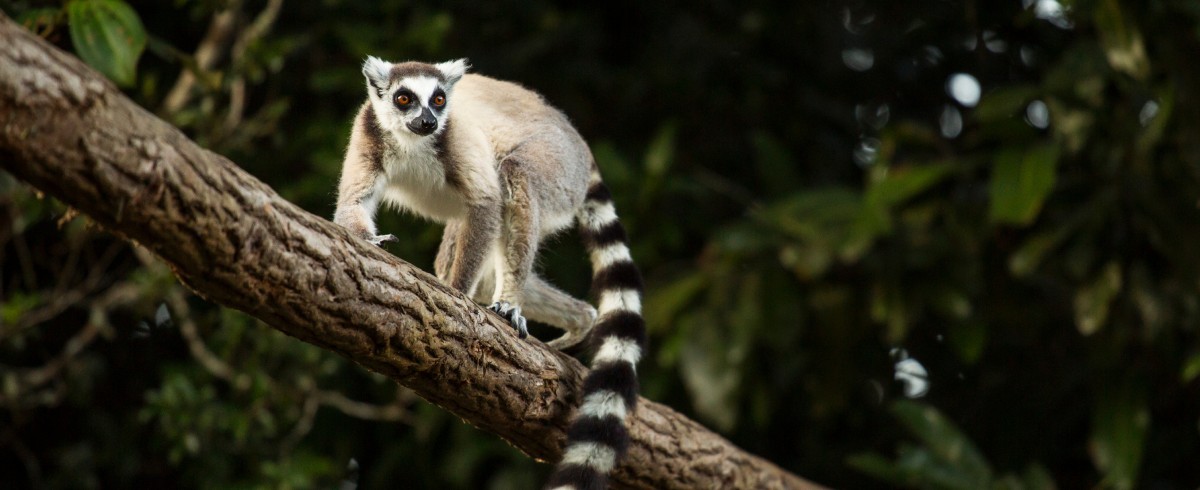

Save the primates campaign
Your Support is important
Sign our petition
BREAKING NEWS
We recently launched a crowdfunding initiative, with the aim of expanding the singing lemurs’ (Indri indri) natural habitat and that of supporting local communities.
Thanks to the precious contribution of Flott, Fondazione Zoom, and dozens of donors, we reached 120% of our goal and thanks to DBios, U Onlus, and the University of Turin we will be able to plant 10,000 trees in 5 hectares and involve dozens of local people.
This fundraising was made possible through the Idea Ginger platform.
To continue supporting the project write to info@worldsustainabilityfoundation.org

Primates are a group of animals that include lemurs, monkeys, apes as well as humans. The first ancestors appeared about 65 million years ago and survived the extinction period of the dinosaurs, like a squirrel with a shrew’s face. Ten million years later the phylogenetic tree of primates began to take shape with strepsyrrhine prosimians (lemurs from Madagascar, Indonesian lories and African bushbabies) and Asian haplorrine tarsiers. The latter group also includes monkeys which are subdivided into platyrrhines (from the New World) and catarrhines (from the Old World).
Each group has evolved independently, and their physical traits have unique characteristics. Some have prehensile tails like the South American aluatta, others have large eyes to see in the dark like tarsiers, or opposable thumbs like gorillas.
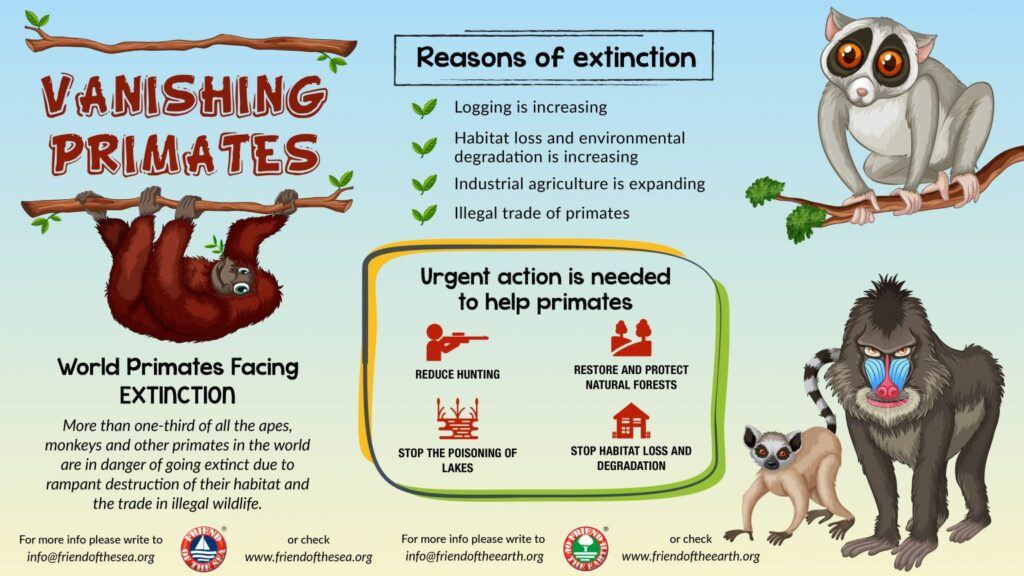
The primary threat to primates worldwide is habitat loss due to human activities like agriculture, mining, and urbanisation, leading to deforestation, desertification, and pollution of natural water reserves.
Poaching and illegal trafficking also contribute to population declines, while illegal captivity as pets causes irreversible psychological traumas. Diseases, some transmissible to humans (e.g., HIV, Ebola, leprosy, and Covid-19), pose another challenge.
Climate change exacerbates issues, with rising temperatures disrupting species’ habitats and increasing droughts, affecting food sources like fruits and flowers.
The introduction of invasive species by pet collectors presents a significant problem, leading to parasitism, food competition, and hybridization that threaten local species’ survival.
PRIMATES STATUS
As per IUCN data, there are 521 species of primates worldwide all of which are members of terrestrial habitats. Now as many as 60% of primate species are at risk of extinction.
The IUCN reported the 25 primate species close to extinction, in the latest 2018-2020 report. Among them stands out the new species of orangutan “Pongo tapanuliensis”, whose genomic differences were identified in 2017, and with only 800 individuals in the wild it is already on the verge of extinction.
Although new species of primates continue to be discovered, especially in tropical forest habitats with naturally dense biodiversity many species have already dwindled to small concerning numbers owing to human activities such as deforestation, mineral extraction, and dams.
References:
- Primates evolution, Lumen Learning: https://courses.lumenlearning.com/boundless-biology/chapter/the-evolution-of-primates/
- Invasive primates, Mongabay: https://news.mongabay.com/2012/03/invasive-primates-threaten-atlantic-forest-natives/
- SciencesAdvances: https://www.science.org/doi/10.1126/sciadv.1600946
- Primates in peril: https://cdn.rewild.org/2019/10/Primates-in-Peril-2018-2020-2.pdf
Possible Solutions
To protect critically endangered, endangered, and vulnerable primates, various actions can be taken:
1. Implement site/area protection, resource/habitat protection, and habitat/natural process restoration through reforestation and afforestation efforts.
2. Limit unsustainable agricultural, forestry, and industrial activities by enacting appropriate laws and regulations.
3. Establish national conservation parks and rescue centres to aid in species recovery, such as the Kibale National Park in Uganda.
4. Conduct species re-introduction through in-situ conservation facilities like rehabilitation centres.
5. Enforce the Convention on International Trade in Endangered Species (CITES) to prevent illegal wildlife trade of primates.
6. Raise awareness about the threatened status of primates through education, training, and media campaigns.
Reference
- Uganda Wildlife Authority: https://www.ugandawildlife.org/explore-our-parks/parks-by-name-a-z/kibale-national-park
- PASA CITES: https://pasa.org/cites/
- PASA List: https://primatecarewelfare.wordpress.com/conservation/law-and-policy/cites-and-cbd/
WSF’s Activities and Initiatives
POLYXENA ASSOCIATION
The World Sustainability Foundation’s Friend of the Earth project supports the Department of Life Sciences and Systems Biology (DBIOS) at the University of Turin (UNITO) and its associated U-ONLUS in Madagascar’s Maromizaha Project. Funding and awareness efforts aid in biodiversity monitoring, particularly of the indri lemur species, and community education in Maromizaha’s New Protected Area. The collaboration facilitates continued indri monitoring, crucial for protection and reforestation.
Since January 2022, the project has worked with Prof. Cristina Giacoma’s research group for 15 years in Maromizaha Reserve. Friend of the Earth funding sustains collective efforts, aiming to monitor indri families using innovative sound analysis techniques. With indri populations critically endangered, the project involves local communities, offering environmental education and scholarships. Women’s involvement in afforestation and nursery maintenance complements scientific conservation efforts, ensuring indigenous heritage protection.
Reference:
- Onlus: https://www.uonlus.it/